

The First May contest for the New Artists and the Live Club
Rome First May concert contest extends the registration’s closing up to 29 february 2016 and opens a special section dedicated to the italian live club’s circuit 1MNext è il contest del Concerto del Primo Maggio di Roma dedicato ai NUOVI ARTISTI. Il bando di concorso dell’1MNext 2016 è già on-line sul sito del Concerto del Primo Maggio www.primomaggio.net/1mnext e la sua scadenza (prevista per il 19 febbraio) viene invece prorogata fino alla mezzanotte del prossimo 29 febbraio 2016. Il Concerto del…
Continua ⇒
Nuoro Ciusa Institute at its first Folk festival

A coloured party that of Saturday 13 February at Nuoro Ciusa Institute, where dozens of students wore traditional costumes giving life to the firs Folk Festival of the school. The Festival “A borghe ‘e ballu” was commissioned by the new Ciusa Folk Group, coordinated by the professor Rita Porcu and strongly supported by the School Leader, professor Francesco Cucca, who has been particularly favorable to let relive in the school moments of intense past revival, strongly connotative of the social…
Continua ⇒
The Piemontese Courenta
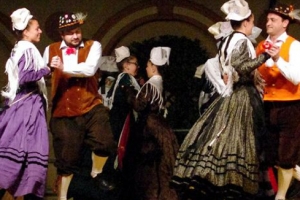
The Courenta (corenta in the normalized Occitan spelling, corrente in Italian) is a common dance in the occitan and french alpine wide valleys. Appeared in the XVI century the courenta develops in the XVII passing from Bransle Courant to two different dances: an italian version, the corrente (rather lively) and a french version, the courante (slowly dance). It was appreciated by King Luigi XIV, who declares it the dance of the ball opening dance, the french courenta disappears in XVIII…
Continua ⇒
The castagnette, neapolitan and calabrian traditional instrument
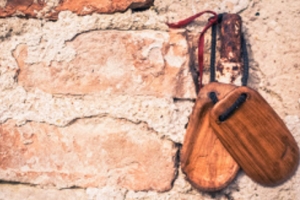
The castagnette are a percussion musical instrument used most of all in the mediterranean popular music, particularly in Campania and Calabria, often confused with the spanish castanets. Each castagnetta is made of two parts, in a shaped wood, tied by a piece of rope that allows the sound to come out opening and closing it with hands. Once closed, they assume the shape of a chestnut from which derives the name. They are used in pairs, even one for hand,…
Continua ⇒
The Irpinia Carnival tradition: the Zeza

The Irpinia Carnival Tradition: the Zeza An important place among the carnival activities is up to the Zeza, an ancient popular performance developed and internalized by the people from Irpinia with the title of Zeza Song, that is represented along the streets by solofrani and montoresi mexed groups. It’s a real popular theatre piece sung and accompanied by instruments like castanets, triccheballacche, tambourines, but also trombone, guitar and trumpet and often bass drum, that was probably born in the second…
Continua ⇒
The Italian Carnival: customs, traditions and dialect proverbs
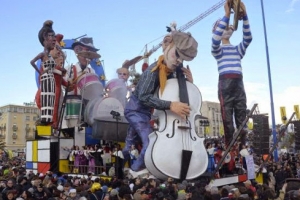
The Carnival is a Celebration of the catholic countries. The celebrations are often public parades in which rule playful and imaginary elements; particularly the distinctive element of the carnival is the costume use. The word carnival derives from the latin carnem levare (“eliminate the meat “), maybe conditiomned also by the latin vale (almost as “goodbye meat!”) because it indicated the banquet of the last carnival day (Fat Tuesday), right before the Lent’s abstinence and fasting period. I festeggiamenti maggiori avvengono…
Continua ⇒
The Canzoniere Grecanico Salentino with Ludovico Einaudi in the new video “Taranta”

New video for the Canzoniere Grecanico Salentino, with the eminent collaboration of Ludovico Einaudi. The video realized by Gabriele Surdo, is in black and white and is extracted by the last group’s album “Quaratnta (Ponderosa)”, that celebrates the band’s 40 years. The faces in the foreground, the instruments protagonists, a rythm that starts, and a swirling dance, from the beginning to the end. “Taranta” (the song’s title) eroded to the essential, squeezed, and for this reason more powerful. Il maestro torinese…
Continua ⇒
CoroMoro, the integration example that gives hope
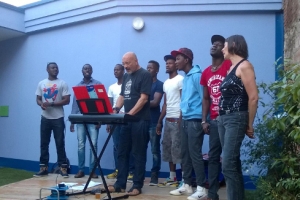
“ CoroMoro ” is a music band composed by 10 enthusiastic “non professionals”: two are italians, the other 8 come from Africa (from Senagal, Gambia, Costa d’Avorio and from Ghana). One of them is a political refugee, the other 7 are asylum seekers. They are arrived to Italy, in the Lanzo valleys, in 2014. They restarted and, to send a strong sharing, integration and anti-racism message, they put themselves out there. They go around the cities and propose, with vitality, irony and…
Continua ⇒


