

The polish traditional Mazurka becomes social
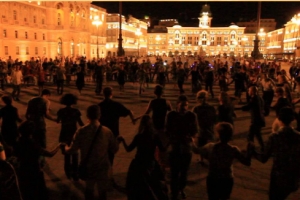
The Mazurca or Mazurka (Mazurek in polish) is a couple dance with a ternary rythm spread in all over Europe. “Mazurka” is a polish word, it was born in Poland as a popular dance (some sources say its origin was in the XVI century), it spread through the middle class in Europe since 1700; its further diffusion since 1800 has been facilitated by the cultured rewrite of some composers. The Mazurka is a spin dance on a ternary time but…
Continua ⇒
La festa dell’Epifania tra cristianesimo e paganesimo

The Epiphany (from the greek epipháneia, divinity’s manifestation) has very old origins that derive from the magic pre-Christian traditions, that in the popular culture become not only religious but also folkloristic. The meaning of the gifts delivered by Befana remembers the gifts offered to Baby Jesus by the Three Wise Men. Its history in a pagan sens take inspiration from a fantastic tale, when they thought that in the night some female figures would fly over the just sown fields to…
Continua ⇒
5 poems dedicated to Befana, the italian poets face the Epiphany
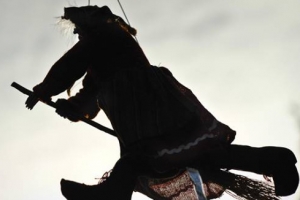
In addition to the famous nursery rhyme “Befana comes in the night”, even some popular italian poets dedicated poetical compositions to Befana, facing the tradition in different ways. Below we show Gianni Rodari, Giorgio Caproni, Guido Gozzano and Giovanni Pascoli’s poems. Oltre alla nota filastrocca “La Befana vien di notte”, anche alcuni noti poeti italiani hanno dedicato dei componimenti poetici alla Befana, affrontando la tradizione in maniera differente. Di seguito riportiamo le poesie di Gianni Rodari, Giorgio Caproni, Guido Gozzano…
Continua ⇒
Ballettu: an agropastoral sicilian dance
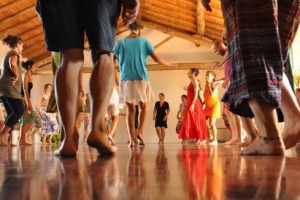
The sicilian Ballettu has some analogies with the southern tarantella wider family; it was performed most of all in a mixed and not mixed couple; many are the local variations, some of them even in the tied and much turned shape (pirullè), so that wide is its musical repertory. Searching the last traces of the traditional agropastoral sicilian tarantas, we find the “Ballettu”, a dance from the mountainous area near Messina, the Peloritani, endangered in its oldest form, but still…
Continua ⇒
Launeddas: The Sound of Sardinia
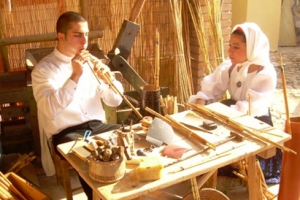
The launeddas are a woodwind musical instrument with knocker reed, originating from Sardinia. The Launeddas are a direct descendant of the ancient double egyptian and sumerian clarinet and have some archaic sections preserved concerning both the building and the execution technique that, at first sight, make them surprisingly similar to their ancient precursors. It is an instrument with very ancient origins able to produce polyphony, it is played with the circular breathing technique and it is built using different kinds…
Continua ⇒
Zampogna in each region, the ultimate Christmas’ instrument

The zampogna is an instrument which sound is produced through air vibration, contained in a flexible tank inserted between the musician’s mouth and several reed aerophones. It was considered, in the classical period, the result of Pan flute’s transformation. From the Middle Ages to the modern era, it has been diversified into many local typologies, among which the scottish and irish indirect inflation bagpipe, the french musetta and the piva. The zampogna has ancient origins: it is probable its lineage…
Continua ⇒
Giuseppe Giuliano’s school and its musical path with Sparagna

The 6 January at Rome’s Auditorium Music Park the students of the Giuseppe Giuliano Inclusive Institute from Latina will be the protagonists of La Chiarastella‘s event, directed by the master Ambrogio Sparagna. We’ve spoken with the Institute’s Principal, the professor Cherubina Ramacci, to deepen the musical question into the schools, to understand how it is situaded inside the educational planning and to know which were the answers coming from the students. Il 6 Gennaio 2016 all’Auditorium Parco della Musica di…
Continua ⇒
Voici venir la nuit, popular song from Valle D’Aosta

Voici venir la nuit’s starting point is a traditional popular song from Valle D’Aosta about the mountain’s contemplation. This is, as most of this region’s popular songs, a french song, characterized by a vocal that slowly deploy on the horizon. A path through different vocal structures that find their place in a melody in which distant bell tolls ring, as to announce the coming of the night. Punto di partenza di Voici venir la nuit è un canto popolare tradizionale valdostano…
Continua ⇒


